
Frequently Bought Together
Description
Book Overview
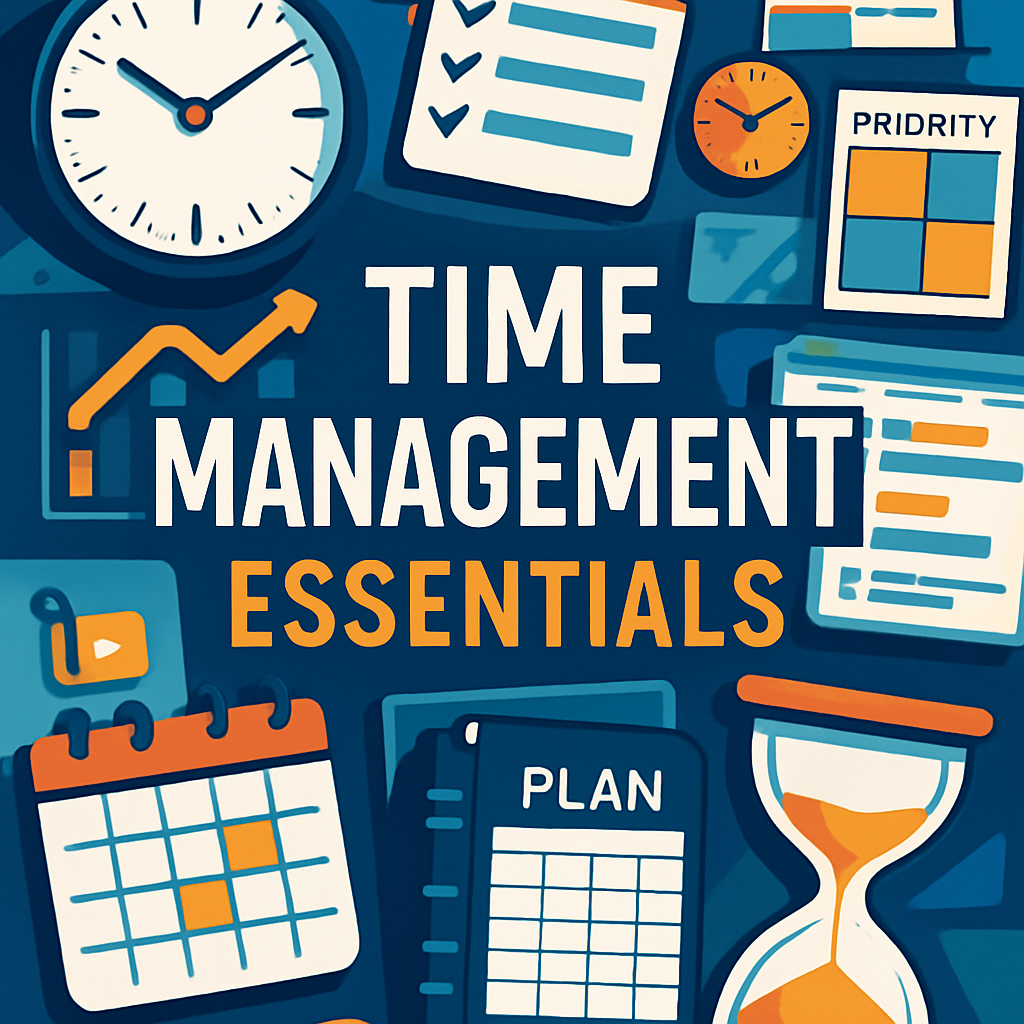
Time Management Essentials: A Beginner’s Roadmap to Productivity is an engaging introduction to the essential skills needed to manage time effectively. In today’s fast-paced world, mastering time management is not just a desirable skill; it is a necessity. This book is designed for complete beginners, offering a comprehensive yet accessible approach to understanding how to prioritize tasks, set meaningful goals, and create schedules that enhance productivity. By breaking down complex concepts into manageable parts, readers will find practical techniques that can be applied immediately to improve their daily routines and overall life satisfaction.
Core Concepts
Prioritization: Understanding how to rank tasks based on urgency and importance.
Goal Setting: Learning how to set SMART goals (Specific, Measurable, Achievable, Relevant, Time-bound) that guide productive behavior. Scheduling: Mastering the art of creating effective schedules that align with personal and professional commitments. Time Blocking: Utilizing dedicated blocks of time for specific tasks to enhance focus and efficiency.
Reflection and Adjustment: Recognizing the need for ongoing evaluation of time management strategies to find what works best for you.
Book Structure
1. Chapter 1: Introduction to Time Management
In this introductory chapter, readers are welcomed into the world of time management with an exploration of its significance in both personal and professional life. The chapter defines key terminology, such as ‘time management’ and ‘productivity’, and provides historical context, tracing the evolution of time management theories from early industrial practices to contemporary approaches. By establishing a strong theoretical framework, this chapter lays the groundwork for readers to understand why effective time management is crucial in achieving success and balance in their lives.
2. Chapter 2: The Art of Prioritization
This chapter delves into the concept of prioritization, teaching readers how to identify what truly matters. By utilizing techniques such as the Eisenhower Matrix, readers learn to distinguish between urgent and important tasks, allowing them to focus their energy on what drives value. Practical examples illustrate how prioritization can transform decision-making processes and enhance productivity. Real-life scenarios encourage readers to practice prioritization in their daily lives, fostering an understanding of how to make choices that align with their goals.
3. Chapter 3: Goal Setting for Success
Goal setting is a powerful tool for enhancing motivation and productivity. This chapter introduces the SMART criteria, guiding readers on how to craft practical goals that are specific, measurable, achievable, relevant, and time-bound. Through relatable examples, the chapter shows how setting goals can provide direction and purpose. Readers are encouraged to reflect on their aspirations and document their goals, with exercises designed to help translate abstract desires into concrete actions. This chapter emphasizes the importance of aligning goals with personal values and long-term objectives.
4. Chapter 4: Scheduling Techniques that Work
In this chapter, readers explore various scheduling techniques that can be tailored to individual preferences and lifestyles. From traditional planners to digital tools, the chapter provides an overview of multiple methods for creating effective schedules. Concepts like time blocking are explained, demonstrating how dedicating specific time slots for different tasks can boost focus and reduce procrastination. Practical exercises encourage readers to develop their own schedules, assess their effectiveness, and make necessary adjustments to optimize their time management strategies.
5. Chapter 5: Reflection and Continuous Improvement
The concluding chapter synthesizes the major concepts covered throughout the book, emphasizing the importance of reflection in the journey of effective time management. Readers are guided to evaluate their progress, celebrate achievements, and identify areas for improvement. The chapter emphasizes the importance of flexibility in time management, encouraging readers to adapt their strategies as their goals and circumstances evolve. By connecting time management skills to broader life goals, this chapter reinforces the idea that effective time management is a lifelong journey of self-improvement and growth.
Learning Approach
This book employs a self-directed learning approach by incorporating various methods such as case studies, practical examples, and theoretical frameworks. Each chapter presents relatable scenarios that illustrate the concepts in action, enabling readers to see how time management techniques can be applied in real-life situations. Reflection questions are included to facilitate deeper understanding and personal connection to the material, while practice problems provide opportunities for hands-on application. This structure equips readers with the tools necessary to explore and master time management independently.
Key Takeaways
After reading Time Management Essentials, readers will have a solid understanding of essential time management concepts, including prioritization, goal setting, and scheduling. They will be equipped with practical strategies that can be easily integrated into their daily lives, enabling them to manage their time more effectively and increase their productivity. Furthermore, readers will develop critical thinking skills as they evaluate their own time management practices and make informed adjustments to align with their goals.
Target Application
The knowledge gained from this book can be applied across various contexts, including academic, professional, and personal. Students can utilize effective time management strategies to balance their studies and extracurricular activities. Professionals can enhance their work efficiency, meet deadlines, and achieve career goals. On a personal level, individuals can use these skills to create more time for hobbies, family, and relaxation. Ultimately, the book empowers readers to take control of their time, thereby improving their quality of life.






Reviews
There are no reviews yet.